Walk into most commercial spaces and the walls are working harder than people realise. They get bumped by trolleys, wiped down by cleaning staff, exposed to steam, grease, condensation, and constant foot traffic. The surface covering on those walls needs to keep up. Wallpaper, for all its visual appeal, often cannot. Vinyl wrap can.
This is not about dismissing wallpaper entirely. It has its uses. But when you are covering walls in a commercial environment, the demands are different from a home living room. This blog breaks down exactly where each material stands, and why most commercial spaces end up better off with vinyl wrap.
Common Failures of Commercial Wallpaper
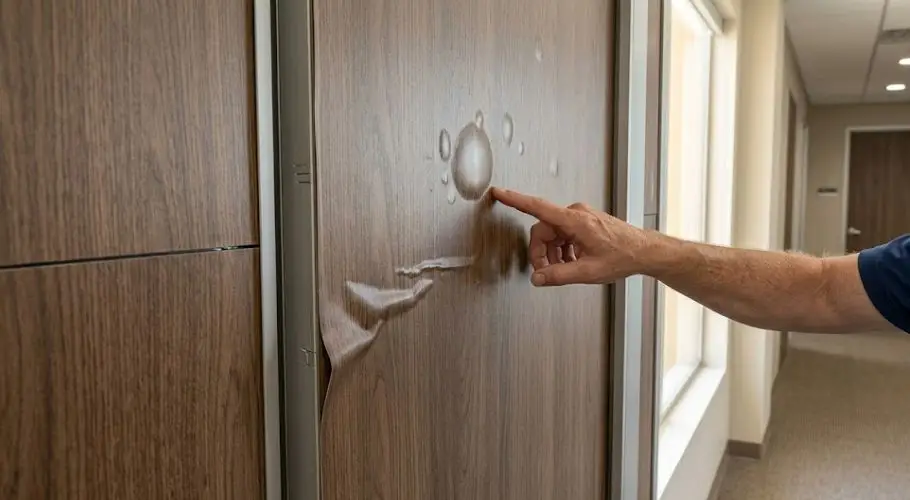
Wallpaper looks good on installation day. The problem is what happens in the weeks and months after that. Commercial spaces have higher humidity, more temperature fluctuation, more cleaning, and more physical contact with walls than any residential setting. Standard wallpaper paste does not love any of those conditions. Seams start to lift. Corners peel. Sections near sinks or kitchens bubble up. Even heavy-duty commercial-grade wallpaper has a ceiling on how much daily wear it can take before it starts to look tired. In most active commercial settings, that ceiling arrives somewhere between three and five years.
Why Architectural Vinyl Wrap is Ideal for Commercial Surfaces
Vinyl wrap is not a wallpaper alternative. It is a different class of product entirely. Architectural-grade vinyl wrap films are manufactured to handle surfaces that see regular cleaning, moisture, physical contact, and UV exposure. They bond directly to the wall and form a sealed surface that does not absorb moisture, does not peel at seams in the same way, and does not stain as easily.
The material itself is scratch-resistant and moisture-resistant. You can wipe it down with standard cleaning products without worrying about damaging the surface or lifting the film. For a commercial space that needs to be cleaned regularly, that alone is a significant practical difference. If you have been exploring commercial surface wrap options for your business, the cleaning and maintenance angle is usually one of the first things that stands out.
Vinyl Wrap vs. Wallpaper: A Side-by-Side Comparison
| Factor | Vinyl Wrap | Commercial Wallpaper |
|---|---|---|
| Average lifespan (commercial use) | 7 to 10 years | 3 to 5 years |
| Moisture resistance | High | Low to moderate |
| Scratch resistance | High | Low |
| Wipe-clean surface | Yes | Partial (coated types only) |
| Seam lifting over time | Minimal | Common |
| Suitable for humid areas | Yes | No |
| Partial repair without full redo | Yes | Difficult |
The lifespan difference alone changes the cost conversation. Wallpaper that needs replacing every three to five years in a commercial setting adds up quickly when you factor in labour, materials, and business downtime for the work to be done.
Cost-Effectiveness of Vinyl Resurfacing vs. Wallpaper
Wallpaper can appear cheaper when you look at the price per roll. That impression does not survive a longer view. Consider what the total cost looks like over ten years for a commercial space. With wallpaper, you are likely looking at at least two replacement cycles in that period, plus repairs along the way for damaged sections. Each replacement involves professional installation, paste, drying time, and the business disruption that comes with having a space out of action.
Vinyl wrap involves a higher upfront material cost in some cases, but the installation is typically faster, the lifespan is longer, and partial repairs are much more straightforward. One damaged panel can be replaced without touching the rest of the wall. With patterned wallpaper, matching a damaged section to an existing installation is difficult, especially if the original batch is no longer in stock. Over a ten-year period, commercial vinyl resurfacing consistently works out as the lower-cost option when maintenance and replacement are factored in.
Applying Vinyl Wrap to Complex Commercial Surfaces
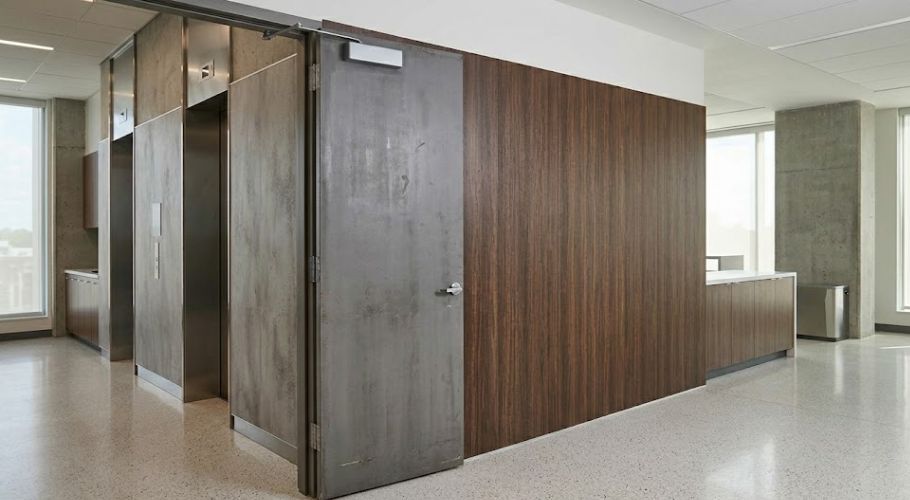
One of the clearest arguments for vinyl wrap in commercial settings is surface compatibility. Vinyl wrap can be applied to walls, columns, MDF panels, laminate surfaces, doors, and even some curved structures. Wallpaper needs a flat, smooth surface to be applied cleanly. Anything irregular, curved, or non-standard is outside its range.
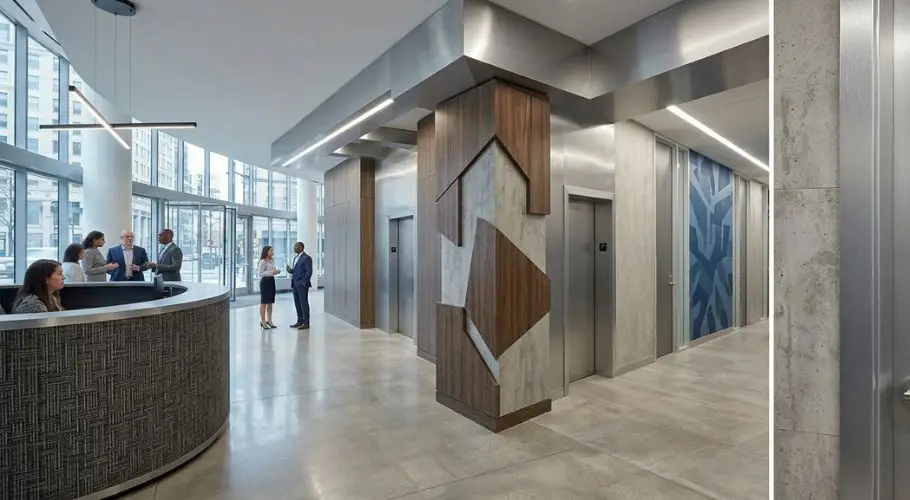
Commercial spaces are rarely all flat walls. Reception desks, feature columns, panelled surfaces, and built-in joinery are common. Vinyl wrap handles all of these. Wallpaper does not. That flexibility matters when you are trying to create a consistent look across an entire commercial interior rather than just covering the easy flat bits.
Commercial Vinyl Wrap Finishes and Design Trends
A common assumption is that wallpaper offers more design variety. That was probably true ten or fifteen years ago. It is not really accurate now.
Vinyl wrap is available in a wide range of finishes, including:
- Wood grain in multiple tones and species
- Stone and concrete textures
- Brushed and polished metal effects
- Matte and gloss solid colours
- Printed custom designs and brand patterns
- Fabric and textile-effect finishes
Wallpaper does offer embossed textures and some traditional decorative patterns that vinyl cannot fully replicate. But for modern commercial interiors, that category is a fairly narrow slice of what most businesses actually need. The practical design range for vinyl wrap covers the vast majority of commercial briefs, and the added benefit is that the same finish holds up for years rather than fading or peeling.
Hygiene and Compliance in Commercial Settings
This is particularly relevant for hospitality, healthcare, and food service environments. Commercial spaces in these sectors often have hygiene and surface standards that need to be met and maintained.
Vinyl wrap advantages for regulated environments:
- Non-porous surface prevents bacteria from embedding in the material
- Easy to disinfect with appropriate cleaning products
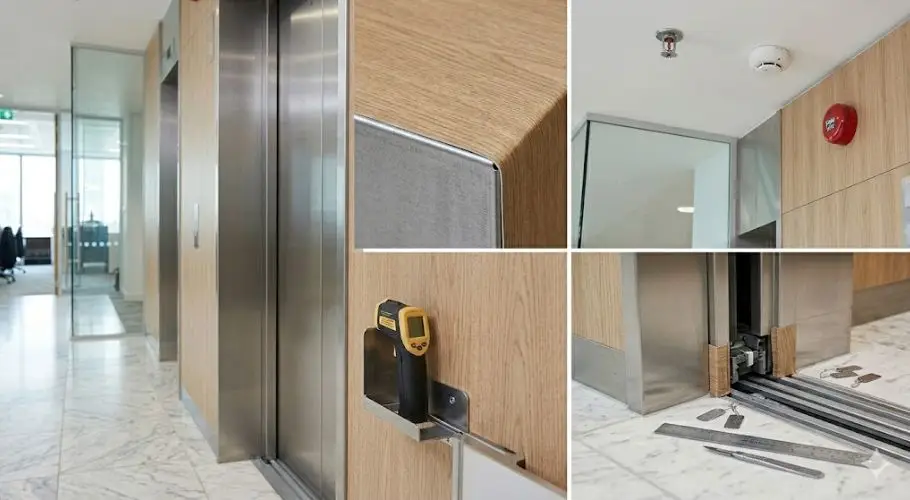
- Architectural-grade films available with relevant fire classifications
- Low VOC options available for enclosed commercial spaces
- No paste or adhesive off-gassing once installation is complete
Wallpaper adhesives can off-gas during and after installation. Paper-based surfaces, even coated ones, are porous to some degree and harder to fully disinfect. In a restaurant kitchen, a hospital corridor, or a gym changing room, that matters. Vinyl wrap is simply a more hygienic surface for the long term in any environment that requires regular deep cleaning.
Reducing Project Timelines with Vinyl Wrap
Business disruption is a real cost that does not always appear on a quote. Wallpaper installation involves paste mixing or soaking, careful sheet alignment, and a drying period before the space can be fully used again. In a humid environment, that drying process takes longer. Any rushed installation shows up quickly in lifted seams or misaligned patterns.
Vinyl wrap installation is cleaner and faster. The surface is prepared, the film is applied in panels, air is worked out, and edges are trimmed. There is no waiting for the paste to dry. The space can typically be put back into use much sooner. For a commercial business that cannot afford extended downtime, this practical difference has real value. If you are planning a refresh for a space that needs to stay operational, it is worth asking your installer about vinyl wrap for commercial interiors and what a realistic turnaround looks like.
When to Choose Wallpaper over Vinyl
To be straightforward about it: wallpaper is not the wrong choice in every situation. In a low-traffic executive office, a boardroom, or a heritage-style space where the aesthetic brief specifically calls for embossed textures and traditional patterns, wallpaper can be appropriate. The key word there is low traffic. In spaces where the walls are rarely touched, rarely cleaned, and rarely exposed to humidity or physical wear, wallpaper holds up better and its visual qualities are more achievable.
But those conditions describe a small portion of commercial spaces. Most offices, retail stores, restaurants, gyms, clinics, and hospitality venues do not fit that description. They need surfaces that can handle real commercial use over a sustained period. That is where vinyl wrap does what wallpaper cannot.
Why Vinyl Wrap is the Superior Commercial Solution
Wallpaper is a decorating material. Vinyl wrap is a commercial surface solution. The difference might sound small, but it shows up clearly in lifespan, maintenance, hygiene, flexibility, and total cost over time.
For any commercial space that sees regular use, the case for vinyl wrap is straightforward. It lasts longer, cleans more easily, works across more surface types, and handles the conditions that come with running a busy business. It is not the flashier option on paper, but it is the one that holds up once the space is open and operational.
If you are ready to look at what vinyl wrap solutions for commercial walls could work for your space, getting a proper assessment done before you commit is the best starting point.