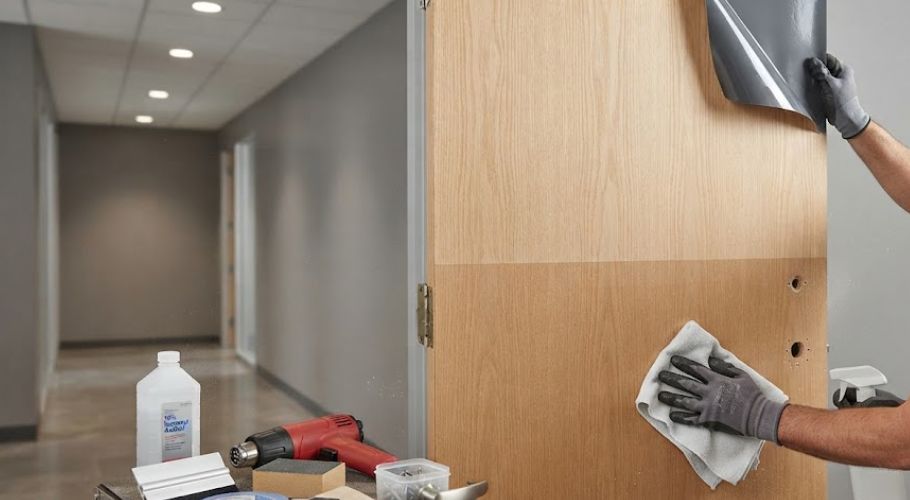
The finish schedule says Class A. A vendor hands you a vinyl architectural film and says it is Class A rated. Your plans examiner is going to ask you to prove it, and the proof is not the brochure.
The short answer: yes, most 3M DI-NOC architectural finishes are Class A under ASTM E84. 3M’s own technical data sheet states it plainly: “Most Products are Class A.” But “most” is not “all,” and more importantly, an ASTM E84 rating describes a tested assembly, meaning the film and what it was applied over. It does not describe a roll of film sitting on a shelf. A spec that says “Class A film” without naming the product series and the substrate is asking for a submittal that cannot be verified.
What does Class A actually mean under ASTM E84?
ASTM E84 is the Steiner tunnel test. A horizontal tunnel chamber of roughly 25 feet, with a 24 foot specimen, the sample mounted to the tunnel ceiling, a gas flame at one end, ten minutes of observation. Results are scaled against two references: fiber cement board is index 0, red oak is index 100. The test produces two numbers, and both matter:
- Flame Spread Index (FSI): how far and how fast flame travels across the surface.
- Smoke Developed Index (SDI): how much smoke the material puts off during the same test.
| Class | Flame Spread Index | Smoke Developed Index |
|---|---|---|
| Class A | 0 to 25 | 0 to 450 |
| Class B | 26 to 75 | 0 to 450 |
| Class C | 76 to 200 | 0 to 450 |
Note the smoke column. The 450 limit is the same for all three classes. A material with an FSI of 10 and an SDI of 500 is not Class A. It is a failure. When a data sheet or a sales rep gives you a flame spread number and stops there, you are missing half the classification.
One more distinction that causes real confusion: ASTM E84 measures surface burning characteristics. It is not a fire resistance rating. It says nothing about whether an assembly holds back fire for 20, 45, or 90 minutes. Those are different tests, and conflating them is the fastest way to get a submittal rejected.
Why does the substrate under the film change the answer?
This is the part that gets skipped, and it is the single most important thing on this page. ASTM E84 does not test a film in isolation. A thin film has to be mounted on something to run through the tunnel, and testing laboratories treat the mounting method as a defined variable. Test programs are commonly offered as separate configurations: unadhered, for material that is wrapped or not glued down directly; adhered to a non-combustible substrate; and adhered to gypsum board. Those are three different tests that can produce three different results for the same material.
This is not a technicality. Published fire research on thin wallcoverings found that a wallcovering “performed differently when tested as a wall assembly” than under standard procedure, and noted that “both the substrate and the air cavity behind the substrate may affect the performance of thin wallcoverings in fire conditions.” A few thousandths of an inch of PVC contributes little fuel on its own. What is underneath it contributes a great deal.
Translate that to your project. Film over Type X gypsum board is not the same tested assembly as the same film over a wood core door, a particleboard casework panel, or an existing plastic laminate. If your schedule requires Class A and the film is going onto a combustible substrate, a Class A report generated over non-combustible board does not automatically carry over.
3M’s US technical data sheet reflects this. It gives the test method and the general statement that most products are Class A, then attaches “Consult 3M Technical Service” to its Industry-Specific Testing line rather than publishing a blanket claim for every finish over every surface.
Practical takeaway: pin down three things together, never one alone. The product series. The substrate. The test report covering both. Confirm the result with your authority having jurisdiction and the current manufacturer data sheet for the exact product you are specifying.
ASTM E84 or NFPA 286: which test does your project need?
ASTM E84 is a bench scale tunnel test. NFPA 286 is a full scale room corner test, and it is a much harder thing to pass.
NFPA 286 lines a room roughly 8 feet by 12 feet with the finish in question, then runs a corner burner: 40 kW for 5 minutes, then 160 kW for another 10. Under the International Building Code, the acceptance criteria are absolute:
- During the 40 kW exposure, flames shall not spread to the ceiling.
- During the 160 kW exposure, flame shall not spread to the outer extremity of the sample on any wall or ceiling.
- During the 160 kW exposure, flashover, as defined in NFPA 286, shall not occur.
- Peak heat release rate throughout the test shall not exceed 800 kW.
- Total smoke released throughout the test shall not exceed 1,000 square meters (10,764 square feet).
Material that passes NFPA 286 is permitted where the code requires Class A interior finish. A harder test, but it satisfies the requirement directly.
When does NFPA 286 come up instead of E84? Two situations. First, the code calls for it by material category: IBC has provisions for textile and expanded vinyl wall coverings that can require a room corner test in addition to, or instead of, ASTM E84. Second, when a material does not behave representatively in the tunnel. NFPA 286 was developed in part to address material displacement seen in E84, meaning material that melts, drips, or falls away from the tunnel ceiling rather than burning in place. Thin thermoplastic films are exactly the category where that question gets asked.
Whether a given architectural film falls under the IBC’s expanded vinyl or textile wall covering provisions is a classification call, and it is not ours to make unilaterally. Expanded vinyl means a foamed product, which most thin architectural films are not, but the determination belongs to the plans examiner. Raise it early rather than at inspection, and confirm the required test path with your AHJ and the current manufacturer data sheet.
Can you apply architectural film to a labeled fire-rated door?
Treat this as a separate question with a separate answer, governed by a different standard. This is the one section where we would rather lose the job than give a comfortable answer.
A labeled fire door carries its rating from its listing, established by fire testing of the complete assembly. NFPA 80 governs what may be done to that assembly afterward. It defines a field modification as changes, not otherwise permitted by the standard, made to a listed assembly or component after it has been manufactured.
The approval path runs through the manufacturer and the listing laboratory, not the installer and not the designer. Permission for changes beyond allowed job site preparations is requested in advance from the manufacturer of the component being modified, who takes it to the listing laboratory. Where the manufacturer is unavailable, the laboratory may be contacted directly and an engineering evaluation supporting the field modification may be provided.
Skip that step and the exposure is concrete. Doors and frames may need to be relabeled by the listing laboratory, which includes a site visit and can be expensive. NFPA 80 also requires annual inspection of fire door assemblies, and inspectors verify that the door, frame, hinges, and glazing all bear legible labels from an approved testing laboratory. Covering or obscuring a fire door label is a compliance problem in its own right, independent of the film’s flame spread number.
So, plainly:
- Non-rated doors, a large share of office and back of house openings, are straightforward door wrap scope.
- Labeled fire-rated doors require a documented approval path before anyone touches them. That means the door manufacturer, the listing laboratory, and your AHJ, in writing, before installation.
- We will not wrap a labeled fire door on the assumption that it is fine. If the approval does not come back, that door stays out of scope or gets replaced.
This matters most in hospitality, where corridor guest room doors are frequently rated. On a hotel door wrap program, rated versus non-rated inventory needs to be surveyed and split before pricing, not after mobilization. 3M’s data sheet does list Intertek Firedoor under industry specific testing and directs readers to 3M Technical Service. We will not characterize what 3M does or does not permit. Ask them in writing for your specific product and door construction.
What should you ask for in the submittal?
Reviewing a film submittal on a Class A project? The package should contain all of the following. Anything less is not reviewable.
- The exact product series and finish code being furnished, not just the brand.
- The current technical data sheet, with its revision code and date visible.
- A test report, not a marketing claim, showing both the Flame Spread Index and the Smoke Developed Index.
- The substrate and mounting method used in that test report, stated explicitly.
- A written statement mapping the tested substrate to the actual project substrates, room by room or door type by door type.
- The applicable code section and required class for each location, from the IBC interior finish table for your occupancy and edition.
- For any labeled fire door: the manufacturer or listing laboratory approval, or a clear notation that those doors are excluded from scope.
- Installer certification, since workmanship affects both appearance and adhesion over the service life.
One note on documentation: 3M publishes region specific data. The US sheet cites ASTM E84 and NFPA 101, while the international sheet cites EN 13501-1 and a Class B-s1, d0 European classification with a separate Declaration of Performance. Those are different regulatory systems. Make sure the document in your submittal is the one that applies in your jurisdiction, at its current revision.
Where does film make sense once the fire question is settled?
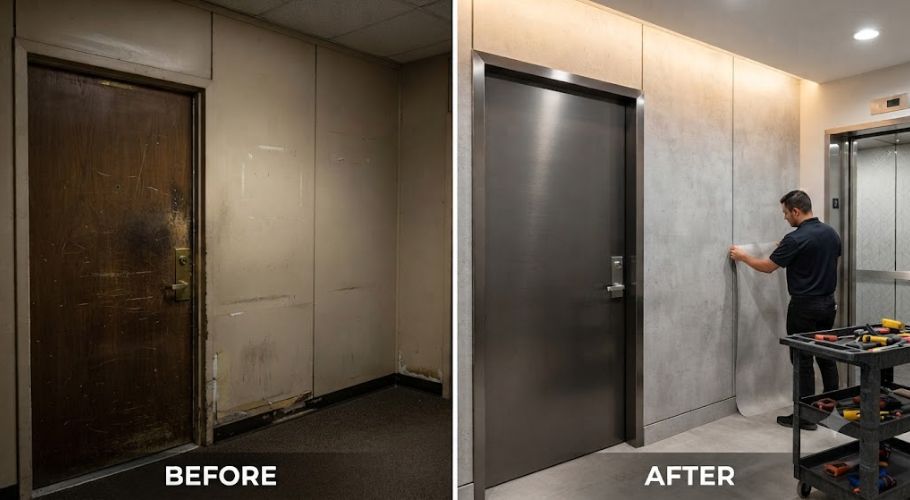
Specifiers push through this analysis because of schedule and cost on occupied buildings. Film goes over existing substrates in place, avoiding demolition, disposal, and long lead times on millwork and doors. On our own projects, AdventHealth in Orlando covered office doors, casework, and ceiling beams, saving roughly $150,000 and 3 to 4 months. A Best Western in Spokane covered 150 guest room doors, room interiors, and an elevator, saving about $200,000 and 6 to 7 months. Everglades University in Boca Raton refinished classroom casework for about $180,000 in savings.
Occupied healthcare environments are where the code analysis is strictest, since institutional occupancies carry the most restrictive interior finish requirements. If you are developing a specification, our resources for designers and architects and wall wrap pages cover typical substrate conditions.
Frequently asked questions
Is 3M DI-NOC Class A fire rated?
3M’s US technical data sheet states that when used in interior applications as defined by NFPA 101, tested by ASTM E84, most products are Class A. It does not say all products, and it directs specific questions to 3M Technical Service. Verify the classification for your exact finish code and substrate.
Does a Class A rating mean the film is fire resistant?
No. ASTM E84 measures surface burning characteristics: flame spread and smoke development across a surface. It is not a fire resistance rating and has no relationship to a 20, 45, or 90 minute assembly rating. Those come from different test standards.
What is a passing smoke developed index?
450 or below, for every class. Class A, B, and C all share the same 450 smoke limit. Only the flame spread ranges differ, at 0 to 25, 26 to 75, and 76 to 200 respectively.
Can architectural film be installed over a fire-rated door?
Not without an approval path. NFPA 80 treats post manufacture changes to a listed assembly as field modifications requiring advance permission from the component manufacturer, who takes it to the listing laboratory. Unapproved work can force relabeling by the listing lab. Labels must also remain legible for the required annual inspection. Get it in writing from the door manufacturer, the listing laboratory, and your AHJ first.
When is NFPA 286 required instead of ASTM E84?
When the code calls for it by material category, such as the IBC provisions for textile and expanded vinyl wall coverings, or when a material does not behave representatively in the tunnel test. Material passing NFPA 286 is permitted where Class A is required. Your plans examiner determines which path applies.
Does the required class change if the building is sprinklered?
Generally yes. The IBC permits a one class reduction in many sprinklered occupancies, though not all: certain high hazard and institutional conditions carry no reduction. Check the interior finish table for your occupancy group, location, and code edition, then confirm with your AHJ.
Next step
If you need the actual test documentation for a specific finish over a specific substrate, we will pull it and tell you honestly where the answer is a clear yes, where it needs a room corner test, and where it needs an AHJ ruling before anyone commits. Contact Resurface Wraps with your finish schedule and door inventory.
Nothing here substitutes for the current manufacturer data sheet, your adopted code edition, or a ruling from your authority having jurisdiction. Confirm all three before you specify.